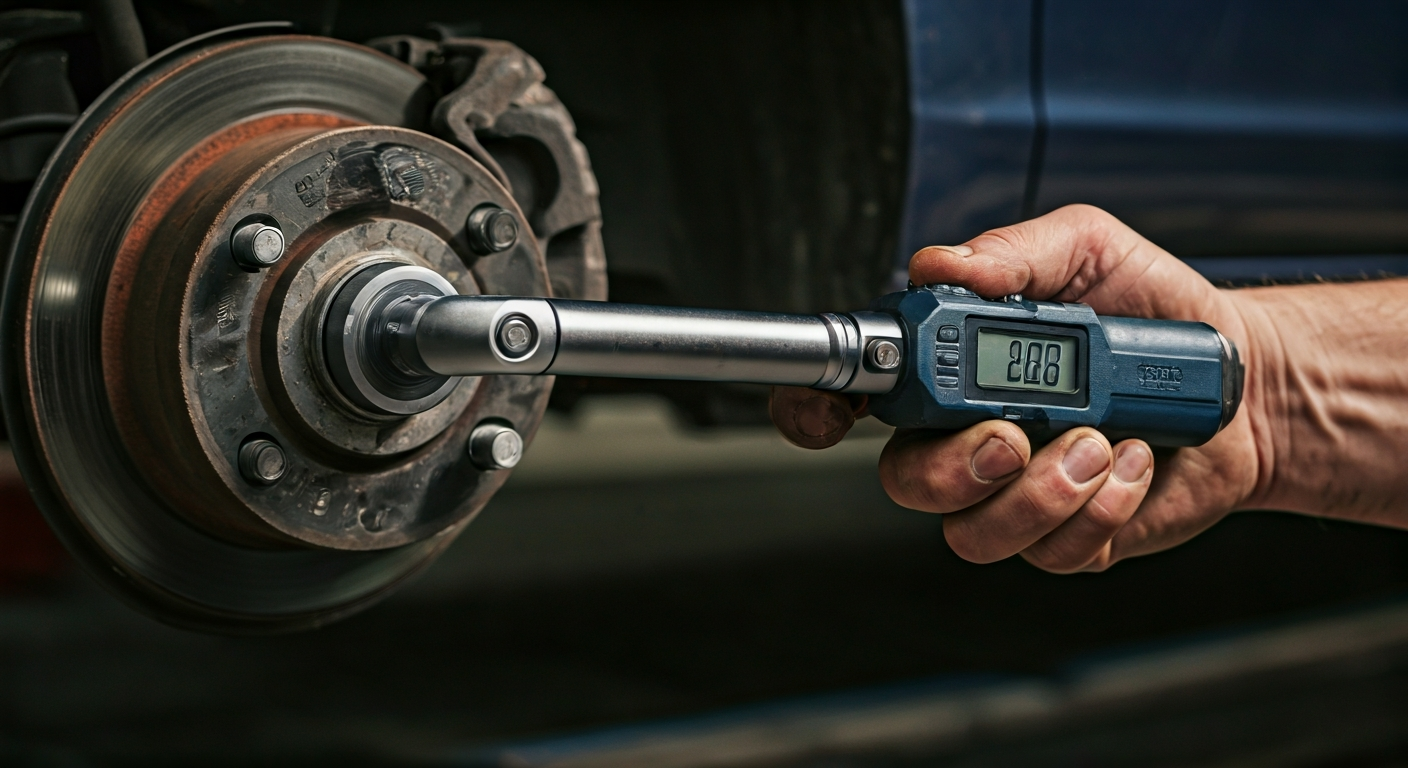
A close-up of a hand using a digital torque wrench to tighten a lug nut on a vehicle's wheel, emphasizing the importance of precise lug nut torque for safety.
How To
Published

Understanding Lug Nut Torque Specifications for Safe Tyre Installation

A
Ali Hassan
Writer
The Answer
Proper lug nut torque is critical for vehicle safety, preventing wheels from loosening or causing damage. Always consult your vehicle's owner's manual for precise specifications. Use a calibrated torque wrench to tighten lug nuts in a star pattern to the exact foot-pound (ft-lbs) or Newton-meter (Nm) value. Re-check torque after 50-100 miles of driving to ensure sustained wheel security.
The seemingly simple act of tightening lug nuts after a tyre change holds profound implications for vehicle safety and performance. Lug nut torque refers to the amount of rotational force applied to the nuts that secure a wheel to its vehicle's hub. Applying the correct torque ensures that the wheel is firmly seated without being overstressed. Incorrect torque, whether too loose or too tight, can lead to serious issues ranging from vibrations and accelerated wear to catastrophic wheel detachment, posing significant risks to drivers and others on the road. Understanding and correctly applying these specifications is a fundamental aspect of vehicle maintenance, extending beyond a basic tyre change to impact long-term reliability and safety.

How to Safely Find and Apply Lug Nut Torque

1

1. Consult Your Owner's Manual for Specifications

Before you begin, locate your vehicle's owner's manual. This is the definitive source for your specific lug nut torque requirements, usually listed in foot-pounds (ft-lbs) or Newton-meters (Nm). Never guess or use generic values, as specifications vary significantly by vehicle make, model, and even wheel type. If your manual is unavailable, reputable online resources from the manufacturer or trusted automotive databases can provide this information.
2

2. Prepare the Vehicle and Tools Safely

Ensure your vehicle is on a flat, stable surface with the parking brake engaged. If you are changing a tyre, follow the steps outlined in our guide on how to change a car tyre. Gather the necessary essential car tyre changing tools, including a calibrated torque wrench, a socket that fits your lug nuts, and a jack and jack stands if removing the wheel. Avoid using lubricants on lug studs or nuts, as this can lead to over-tightening.
3

3. Clean Mating Surfaces

Before installing the wheel, ensure that the wheel's mounting surface and the vehicle's hub face are clean and free of rust, dirt, or debris. Any foreign material between these surfaces can prevent the wheel from seating correctly, leading to inaccurate torque readings and potential loosening.
4

4. Hand-Tighten Lug Nuts

Place the wheel onto the hub, aligning the bolt holes. Install all lug nuts by hand, turning them until they are finger-tight. This ensures proper thread engagement and prevents cross-threading, a common issue that can damage both the lug nuts and the wheel studs.
5

5. Torque Lug Nuts in a Star Pattern

Lower the vehicle partially until the tyre just makes contact with the ground, preventing the wheel from spinning freely. Set your torque wrench to the specified value from your owner's manual. Begin tightening each lug nut in a star (or crisscross) pattern. This method ensures even pressure distribution across the wheel hub, preventing warping or misalignment. Tighten in two or three passes: first to about half the specified torque, then to three-quarters, and finally to the full torque setting. Listen for the 'click' of the torque wrench to confirm the correct torque has been reached.
6

6. Lower Vehicle and Final Check

Once all lug nuts are torqued, fully lower the vehicle to the ground and remove the jack. Perform a quick visual inspection to ensure all nuts appear properly seated. Do not re-torque after the initial torque has been applied, as this can lead to overtightening.
7

7. Re-check Torque After Driving

It is crucial to re-check the lug nut torque after driving approximately 50-100 miles (80-160 km). This step accounts for any initial settling or minor expansion/contraction that might occur. Using your torque wrench, re-check each lug nut in the same star pattern. If any nuts have loosened slightly, re-torque them to the specified value. This practice is a vital safety measure that ensures lasting wheel security.

Why Lug Nut Torque is Crucial for Safety and Performance

The seemingly small detail of lug nut torque is, in fact, a cornerstone of vehicle safety and mechanical integrity. Lug nuts are designed to create a clamping force that holds the wheel securely against the vehicle's hub. This clamping force, achieved through precise torque, is what prevents the wheel from moving relative to the hub. Without sufficient and uniform clamping force, a wheel can experience various detrimental effects that compromise safety and lead to costly repairs.
When lug nuts are under-tightened, the clamping force is insufficient. This allows the wheel to vibrate and shift, especially during braking, acceleration, or cornering. Over time, this movement can cause the lug nuts to loosen further, leading to excessive wear on the wheel studs, lug holes in the wheel, and even the hub itself. In severe cases, an under-torqued wheel can detach from the vehicle entirely while in motion, resulting in a catastrophic loss of control and a significant accident risk. Moreover, loose wheels often manifest as steering wheel vibrations or unusual noises, which should be immediately investigated.
Conversely, overtightening lug nuts introduces a different set of dangers. Applying excessive torque can stretch and weaken the wheel studs, leading to their eventual failure. It can also warp brake rotors due to uneven clamping pressure, causing pulsation during braking and premature wear. Additionally, overtightening can strip the threads of the lug nuts or studs, making future tyre changes difficult or impossible without replacing damaged components. In extreme cases, it can crack or deform the wheel itself. Balancing the need for a secure wheel with the risk of damaging components underscores the importance of adhering to manufacturer-specified torque values. For more general information on tire safety, consult resources like NHTSA's Tire Safety Tips.

Key Terms Explained

Lug Nut
A fastener, usually hex-shaped, used to secure a wheel to a vehicle's hub. It threads onto a wheel stud.
Wheel Stud
A threaded rod pressed into the wheel hub or axle flange, onto which lug nuts are threaded to hold the wheel.
Torque Wrench
A precision tool used to apply a specific, measurable amount of rotational force (torque) to a fastener, ensuring it is tightened correctly without overtightening or under-tightening.
Torque Specification
The exact amount of rotational force, typically measured in foot-pounds (ft-lbs) or Newton-meters (Nm), that should be applied to a fastener to achieve the correct clamping force.
Foot-Pound (ft-lbs)
A unit of torque measurement, representing the force of one pound applied to a lever one foot long. Common in the United States.
Newton-Meter (Nm)
A unit of torque measurement in the International System of Units (SI), representing the force of one Newton applied at a radius of one meter. Common internationally.
Star Pattern (Crisscross Pattern)
A method of tightening lug nuts where fasteners are tightened sequentially across from each other (e.g., 1-3-5-2-4 on a five-lug wheel) to ensure even clamping pressure and prevent wheel warping.
Clamping Force
The compressive force exerted by a tightened fastener (like a lug nut) that holds two or more components (like a wheel and hub) securely together.

Typical Lug Nut Torque Specifications by Vehicle Type (Examples)

Vehicle TypeCommon Torque Range (ft-lbs)Notes
Small Sedan/Compact Car70-90e.g., Honda Civic, Toyota Corolla
Mid-size Sedan/Family Car80-100e.g., Toyota Camry, Ford Fusion
Crossover SUV/Small Truck90-120e.g., Honda CR-V, Ford Ranger
Full-size SUV/Light Truck100-150e.g., Ford F-150, Chevrolet Tahoe
European Luxury Vehicles~88-103 (120-140 Nm)Often specified in Nm; confirm with manual

The Right Tools for Accurate Torque Application

Achieving the precise torque required for lug nuts necessitates the use of the correct tools, primarily a torque wrench. While basic lug wrenches or impact wrenches can loosen or initially tighten nuts, only a torque wrench provides the accuracy needed for the final, critical tightening step. There are several types of torque wrenches, each with its own advantages and suitable for different levels of precision and user preference.
Click-type torque wrenches are the most common and generally recommended for automotive applications. They feature an internal mechanism that 'clicks' or breaks when the preset torque value is reached, providing a clear tactile and audible indication. Digital torque wrenches offer even greater precision, displaying the torque value on a screen and often providing audio/visual alerts upon reaching the target. Beam-type torque wrenches are simpler, showing the applied torque on a scale as the beam deflects, but they require a clear line of sight and careful reading.
Regardless of the type, it's essential that your torque wrench is properly calibrated. Over time, or with improper use (e.g., dropping it, using it as a breaker bar), torque wrenches can lose their accuracy. It's advisable to have your torque wrench checked periodically or to invest in a quality tool from a reputable manufacturer. Crucially, impact wrenches should only be used for loosening lug nuts or for initial, light tightening; they should never be used for final torque application due to their inability to consistently deliver precise torque, which can easily lead to overtightening or under-tightening.

Critical Safety Tip: Always Re-Torque After Driving

Even when lug nuts are initially torqued correctly, they can sometimes loosen slightly after the wheel settles into place or due to expansion and contraction from heat cycles during initial driving. For this reason, it is a critical safety best practice to re-check all lug nut torques after driving approximately 50-100 miles (80-160 km) following any wheel removal or tyre change. This simple step helps prevent dangerous situations by ensuring the wheel remains securely attached.

Ensuring Wheel Security: A Summary

Key Takeaways

  • Prioritize Safety: Correct lug nut torque is non-negotiable for vehicle safety, directly impacting wheel retention and overall driving stability.
  • Consult Your Manual: Always refer to your vehicle's owner's manual for the precise, vehicle-specific torque specifications in foot-pounds (ft-lbs) or Newton-meters (Nm).
  • Use the Right Tools: A calibrated torque wrench is essential for applying accurate torque. Avoid impact wrenches for final tightening.
  • Follow the Star Pattern: Tighten lug nuts in a star (crisscross) pattern to ensure even clamping force and prevent wheel warping or loosening.
  • Re-check is Critical: After driving 50-100 miles post-installation, always re-check lug nut torque to account for settling and maintain optimal security.
  • Avoid Lubrication: Do not lubricate lug nuts or studs unless specifically instructed by the manufacturer, as this can lead to dangerous overtightening.

Common Questions About Lug Nut Torque

Was this guide helpful?

Your feedback helps our writers improve this help center.

Helpful for 18 readers

About the Author

A
Ali Hassan
Expert Author
Writer

"Professional writer."

Related Guides

See All Topics
A person confidently changing a car tire on a paved road, using a lug wrench and car jack, with a spare tire ready.

To safely and efficiently change a car tyre, first ensure a safe location, apply the parking brake, and activate hazard lights. Gather your spare tyre, jack, and lug wrench. Loosen the lug nuts before jacking up the car. Lift the vehicle, remove the flat tyre, install the spare, and hand-tighten the nuts. Lower the car, then fully tighten the lug nuts in a star pattern. Drive cautiously to the nearest service centre.

15 Found This Helpful
Read Guide
A person in a reflective vest safely changing a car tire on the side of a road, with hazard lights on and a warning triangle visible. The scene emphasizes roadside safety.

To ensure roadside safety when changing a tyre, prioritize finding a safe, level location away from traffic. Immediately activate hazard lights, deploy a warning triangle or flares, and wear a reflective vest. Ensure your vehicle is stable with the parking brake engaged and wheels chocked before beginning. Always stay vigilant of your surroundings to protect yourself, passengers, and other motorists.

11 Found This Helpful
Read Guide
A cross-section view of a run-flat tyre clearly showing its thick, reinforced sidewall designed to support the vehicle after a puncture, with 'RUN-FLAT TECHNOLOGY' text.

Run-flat tyres are specialized car tyres designed to continue functioning safely for a limited distance and speed after experiencing a puncture and losing air pressure. They achieve this through reinforced sidewalls or internal support rings, preventing the tyre from collapsing entirely. This allows drivers to reach a service station without an immediate roadside tyre change, enhancing safety and convenience.

1 Found This Helpful
Read Guide
BroadMatters LogoBroadMatters

Clear, simple guides and everyday explanations to help you solve common problems with confidence.

Stay Updated

Get our latest guides and simple tips delivered directly to your inbox.

By joining, you agree to our Terms and Privacy Policy.

© 2026 BroadMatters Help Center. All rights reserved.

contact@broadmatters.com