
A Simple Definition
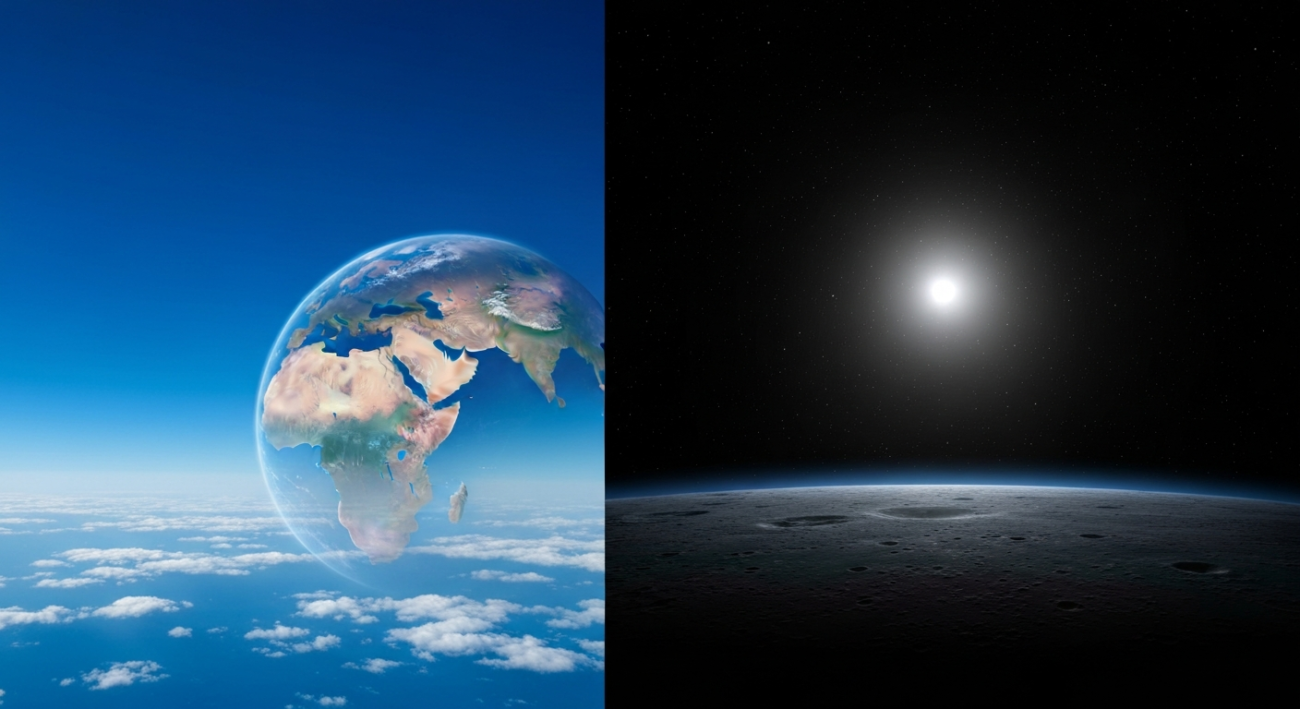
The Earth’s sky appears blue due to the scattering of sunlight by its atmosphere, while the Moon’s sky appears black because it lacks an atmosphere to scatter light.
An Easy-to-Understand Explanation
Have you ever looked up at the sky and wondered why it’s blue? It’s a question many of us have asked! The simple answer lies in something called Earth’s atmosphere. Imagine our planet is wrapped in a thick blanket of air. When sunlight, which contains all colors of the rainbow, passes through this blanket, it interacts with the tiny gas molecules within. Blue light, with its shorter wavelengths, gets scattered in all directions much more than other colors. This scattered blue light reaches our eyes from every angle, making the sky appear blue. Now, picture the Moon. It doesn’t have this protective blanket of air. It’s essentially in a vacuum. So, when sunlight hits the Moon, there’s nothing there to scatter the light. If you were standing on the Moon, even with the sun shining brightly, the sky above you would look black, and you’d see stars clearly in the daytime because there’s no atmosphere to diffuse the light. That’s the fundamental reason why the sky is blue on Earth but not on the Moon.
History and Origin of Understanding Sky Color
For centuries, the blue color of Earth’s sky was a topic of scientific curiosity. Early theories ranged from the reflection of the oceans to moisture in the air. However, it wasn’t until the 19th century that a precise scientific explanation emerged. In the 1870s, British physicist Lord Rayleigh provided the definitive answer. He explained that the scattering of light by particles much smaller than the wavelength of light—like the gas molecules in Earth’s atmosphere—is inversely proportional to the fourth power of the wavelength. This phenomenon, now known as Rayleigh scattering, brilliantly explains why shorter wavelength blue light is scattered more intensely than longer wavelength red light. The understanding that an atmosphere is key to this phenomenon also clarified why celestial bodies without significant atmospheres, like the Moon, would have a black sky. This scientific breakthrough revolutionized our understanding of light, atmosphere, and planetary appearance.
Key Related Terms
Rayleigh Scattering: The scattering of electromagnetic radiation (like light) by particles of a much smaller wavelength, causing shorter wavelengths (blue light) to scatter more efficiently.
Wavelength: The distance between successive crests of a wave, determining its color in the visible spectrum.
Vacuum: A space entirely devoid of matter, or an enclosed space from which most of the matter has been removed.
Electromagnetic Spectrum: The range of all types of electromagnetic radiation, including visible light, radio waves, X-rays, and more.
How the Sky’s Color Actually Works
- Sunlight, a mix of all visible colors, travels through space towards Earth. These colors have different wavelengths, with blue and violet having shorter ones, and red and orange having longer ones.
- Upon entering Earth’s atmosphere, sunlight encounters countless tiny gas molecules, primarily nitrogen and oxygen. These molecules are much smaller than the wavelengths of visible light.
- Due to Rayleigh scattering, these tiny molecules are far more effective at scattering shorter-wavelength light (blue and violet) than longer-wavelength light (red, orange, yellow). Think of it like a billiard ball hitting a smaller ball; the smaller ball gets knocked around more.
- The scattered blue and violet light disperses across the sky, coming to our eyes from all directions. This makes the sky appear blue. Our eyes are more sensitive to blue than violet, so we perceive a blue hue.
- Meanwhile, the longer-wavelength red and yellow light passes through the atmosphere with less scattering, continuing on a more direct path. This is why the sun appears yellow-white when high in the sky and can lead to beautiful red sunsets and sunrises when sunlight travels through more atmosphere.
- Now, consider the Moon. It possesses a negligible atmosphere, often described as a near-perfect vacuum. Without the gas molecules to scatter sunlight, the light travels directly to the lunar surface or astronaut’s eyes without interference.
- Therefore, on the Moon, there is no atmospheric scattering to diffuse blue light across the sky. The sky appears pitch black, even when the Sun is shining, and stars are visible because there is no ambient light to obscure them. This is the core scientific reason why space looks black and the moon’s sky is black, directly answering why is the sky blue on Earth but not on the Moon?
A Real-Life Example: Sunsets and Sunrises
You’ve experienced the science of light scattering many times without even realizing it, especially during sunsets and sunrises. When the sun is high in the sky, its light travels through less of Earth’s atmosphere. Most of the blue light is scattered away, making the sky blue. But during sunrise or sunset, the sun’s light has to travel a much longer path through the atmosphere to reach our eyes. As it travels this longer path, even more of the blue and violet light gets scattered away from our line of sight. What’s left are the longer wavelengths – the reds, oranges, and yellows – which continue more directly to our eyes, creating those breathtaking colorful displays we cherish. This everyday phenomenon perfectly illustrates the principle of Rayleigh scattering and how the amount of atmosphere light passes through dramatically affects the colors we see.
Why This Concept is Important
Understanding why is the sky blue on Earth but not on the Moon isn’t just a fascinating trivia fact; it highlights fundamental differences between planetary bodies and the conditions necessary for life. Earth’s atmosphere, responsible for our blue sky, is much more than just a light-scattering medium. It’s a vital shield that protects us from harmful solar radiation, regulates our planet’s temperature, and provides the breathable air we need to survive. The absence of a substantial atmosphere on the Moon means it lacks these protections, making it a harsh, lifeless environment. This comparison underscores the critical role our atmosphere plays in making Earth habitable and beautiful. It’s a reminder of the delicate balance of conditions that allow life to thrive on our planet, influencing everything from weather patterns to the very color of our world.
Broader Implications and Future of Planetary Observation
The concept of atmospheric scattering extends beyond Earth and the Moon, offering crucial insights into exoplanet studies and the search for extraterrestrial life. By observing the light passing through the atmospheres of distant planets, scientists can deduce their composition and density. A ‘blue’ sky might indicate a nitrogen-oxygen rich atmosphere similar to Earth, while a ‘red’ or ‘orange’ sky could suggest different atmospheric gases or particulate matter, like on Mars. This knowledge helps us identify potentially habitable worlds. As space exploration advances, understanding atmospheric effects becomes even more critical for designing missions and interpreting observations from other celestial bodies. The fundamental principles behind why is the sky blue on Earth but not on the Moon are therefore at the forefront of astrobiology and planetary science, guiding our quest to understand the universe and our place within it.
Common Myths Debunked
- Myth: The sky is blue because it’s a reflection of Earth’s oceans. Truth: While the oceans are blue, the color of the sky is an independent atmospheric phenomenon caused by light scattering, not reflection. If Earth were covered in red soil, the sky would still be blue.
- Myth: The Moon has no ‘sky’ at all. Truth: The Moon certainly has a ‘sky’ in the sense of the space above its surface. However, due to the lack of an atmosphere, this sky appears black to an observer on the lunar surface, even during lunar daytime.
- Myth: Space is completely empty. Truth: While space is largely a vacuum, it’s not entirely empty. It contains trace amounts of gas, dust, and various forms of radiation, though not enough to cause significant light scattering like Earth’s atmosphere.
Test Your Knowledge
Question: What is the primary reason Earth’s sky appears blue, a phenomenon absent on the Moon?
Answer: Earth’s atmosphere, which scatters shorter-wavelength blue light more effectively than other colors due to Rayleigh scattering.
Final Summary
In summary, the dramatic difference in sky color between Earth and the Moon boils down to one critical factor: the presence of an atmosphere. Earth’s robust atmosphere, filled with tiny gas molecules, acts as a filter, scattering blue light across the sky and giving our world its iconic azure hue. Conversely, the Moon’s near-total lack of an atmosphere means there’s nothing to scatter sunlight. Consequently, its sky remains perpetually black, even under the direct glare of the sun. This simple yet profound distinction highlights the unique conditions that make Earth a vibrant, life-sustaining planet, setting it apart from its barren lunar neighbor.
