
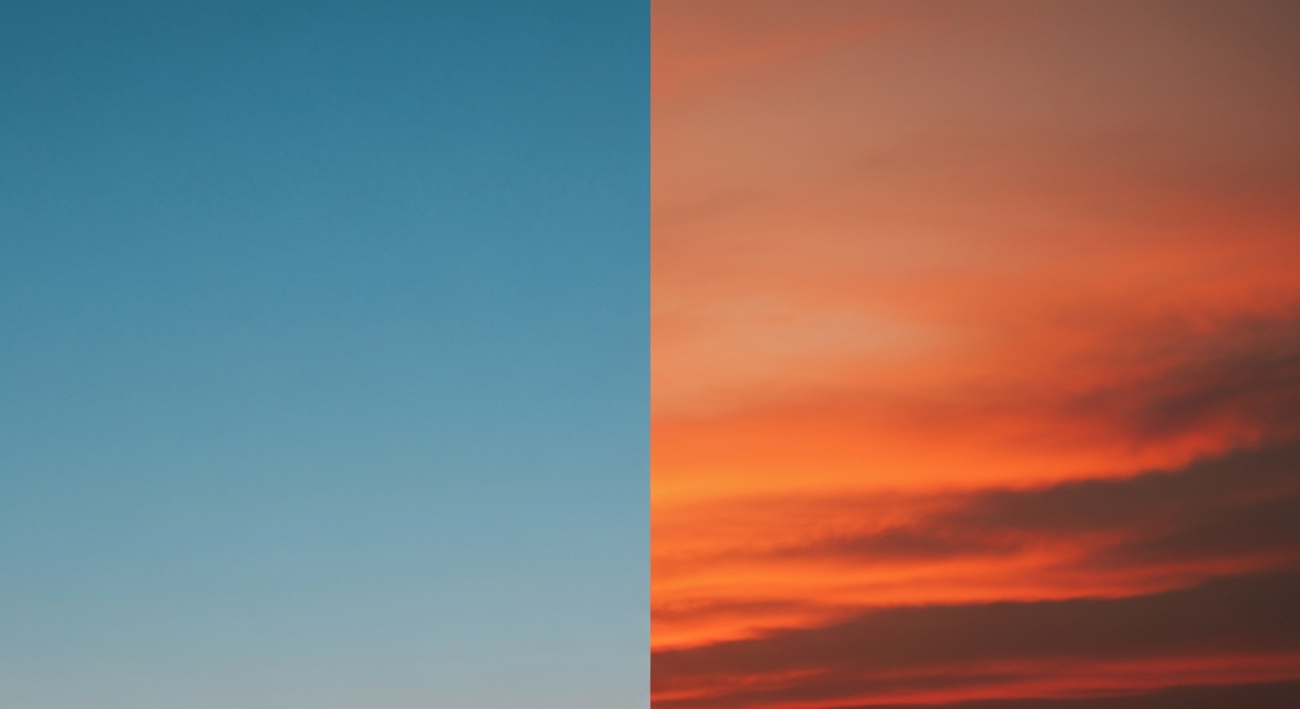
A Simple Definition of Sky Color Changes
The Earth’s atmosphere scatters sunlight, making the sky appear blue during the day and often orange, red, or pink during sunrises and sunsets.
An Easy-to-Understand Explanation
Have you ever looked up and wondered why the sky is blue? It’s all thanks to how sunlight interacts with our atmosphere. Sunlight, which looks white to us, is actually made up of all the colors of the rainbow. When this sunlight enters Earth’s atmosphere, it bumps into tiny gas molecules and particles. Blue light waves are shorter and scatter more easily than other colors. This scattering effect spreads blue light all across the sky, making it appear that signature sky blue color we see most of the day. As the sun dips lower in the sky during sunrise or sunset, the light has to travel through much more of the atmosphere. This longer journey causes even more blue light to scatter away, leaving behind the reds, oranges, and yellows that paint our stunning evening and morning skies.
History and Origin of Understanding Atmospheric Colors
For centuries, people have marveled at the colors of the sky, but understanding the science behind it is a relatively modern achievement. Ancient civilizations often attributed the sky’s colors to gods or mystical forces. It wasn’t until the 19th century that scientists began to unravel the true physical mechanisms. John Tyndall, an Irish physicist, made significant contributions in the 1860s by demonstrating that very fine particles could scatter blue light more effectively than red light. This phenomenon, known as the Tyndall effect, paved the way for a more complete explanation. Later, in 1871, British physicist Lord Rayleigh provided the mathematical framework for this scattering, specifically for particles much smaller than the wavelength of light. His work, now known as Rayleigh scattering, precisely explains why the sky is blue and why sunsets are red. It was a groundbreaking moment in atmospheric optics, moving our understanding from mere observation to precise scientific explanation.
Key Related Terms
Atmosphere: The layers of gases surrounding the Earth, primarily nitrogen and oxygen, which play a crucial role in scattering sunlight and creating sky colors.
Electromagnetic Spectrum: The full range of electromagnetic radiation, including visible light, which is composed of different colors, each with its own wavelength.
How Sky Colors Actually Work
- Sunlight is composed of a spectrum of colors, each with a different wavelength. Blue and violet light have shorter wavelengths, while red and orange light have longer wavelengths.
- During the day, when the sun is high, sunlight travels through less of Earth’s atmosphere. As it passes through, blue light experiences more Rayleigh scattering by tiny nitrogen and oxygen molecules. These small particles are much smaller than the wavelengths of visible light.
- Because blue light scatters in all directions more efficiently than other colors, the entire sky appears a brilliant sky blue. The other colors, like red and yellow, pass through the atmosphere more directly, allowing the sun itself to appear yellow or white.
- At sunrise or sunset, the sun is low on the horizon. This means sunlight has to travel through a much thicker and longer section of the atmosphere before reaching our eyes. This extended path forces the blue and even some green light to scatter away almost completely.
- With most of the blue light scattered out of the direct path, the remaining light waves — predominantly the longer-wavelength reds, oranges, and yellows — are what we see. These vibrant hues create the spectacular sunsets and sunrises we all admire.
- Particles like dust, pollution, and water droplets can enhance this effect, leading to even more dramatic and fiery reds and oranges in the sky during these times.
A Real-Life Example of Sky Color
Think about looking at the sky on a clear summer afternoon. It’s a vivid, bright blue, sometimes almost purple near the zenith. This is a perfect example of Rayleigh scattering in action, where the blue light is spread all around us. Now, imagine watching the sun go down over a vast ocean or a desert landscape. The sky transforms, shifting from yellow to brilliant oranges, deep reds, and even purples. This dramatic change illustrates how the increased atmospheric path filters out blue light, leaving behind the longer, warmer wavelengths to create a breathtaking display. You can even see a similar effect if you shine a flashlight through a glass of water with a few drops of milk; the milk particles will scatter the blue light, making the light appear reddish as it passes through.
Why This Concept is Important
Understanding why the sky is blue and why sunsets are orange isn’t just a fun scientific fact; it’s fundamental to comprehending our planet’s atmosphere and light itself. This knowledge has practical applications, too. It helps meteorologists understand atmospheric conditions, light pollution experts track how light interacts with the air, and even artists create more realistic and evocative landscapes. It underscores the delicate balance of gases in our atmosphere that makes life on Earth possible. Furthermore, it highlights the universal principles of physics that govern light and matter, both on Earth and in the cosmos. Knowing these principles helps us appreciate the beauty of our world on a deeper, more scientific level.
Broader Implications and Future Insights
The principles of Rayleigh scattering extend far beyond Earth’s sky. This same physics helps explain why other planets, if they have atmospheres, might have different colored skies. For instance, Mars has a very thin atmosphere with lots of dust, which often makes its sky appear a yellowish-brown during the day and blue around the setting sun – the opposite of Earth! This also has implications for understanding light pollution and how aerosols in our atmosphere affect visibility and climate. As we continue to study Earth’s atmosphere and explore others in our solar system, understanding how light interacts with various atmospheric compositions will remain crucial. Future research might involve more detailed modeling of atmospheric scattering to predict climate change impacts or to inform astrobiological explorations when searching for life on exoplanets. Understanding the basic phenomenon of why the sky is blue is a stepping stone to unlocking even greater mysteries of the universe.
Common Myths Debunked About Sky Colors
- Myth: The sky is blue because it’s a reflection of the oceans. Fact: While oceans can reflect light, the blue color of the sky is primarily due to the scattering of sunlight by atmospheric gases, not reflections from water. Even if Earth were covered entirely by land, the sky would still be blue.
- Myth: The sky is always blue everywhere. Fact: The sky’s color varies significantly based on time of day, weather conditions, and atmospheric composition. Sunsets show this perfectly. Also, the sky on other planets can have different colors depending on their atmospheres.
- Myth: Pollution makes sunsets more colorful in a good way. Fact: While certain particles can enhance reds and oranges by scattering more blue light, severe air pollution can actually make sunsets appear dull, hazy, or even brown by obscuring the sun and scattering all colors indiscriminately. Cleaner air often leads to clearer, more vibrant sunsets.
Test Your Knowledge
Question: What scientific phenomenon is primarily responsible for the sky appearing blue during the day?
Answer: Rayleigh scattering.
Final Summary
The captivating transformation of our sky, from its vibrant daytime blue to the fiery oranges and reds of sunset, is a beautiful everyday science lesson. It’s all thanks to how sunlight interacts with Earth’s atmosphere through a process called Rayleigh scattering. Blue light, with its shorter wavelengths, scatters more effectively, painting our sky blue. As the sun dips lower, its light travels through more atmosphere, scattering away the blue and revealing the warmer hues. This fundamental concept not only explains the beauty above us but also underpins our understanding of light, atmosphere, and even other planets.
Frequently Asked Questions
Why does the sky sometimes look purple?
Occasionally, especially after a storm or during sunrise/sunset, the sky can appear purple. This happens when blue light, already heavily scattered, mixes with the direct red light that manages to penetrate the atmosphere, creating a purplish hue. The combination of very short (violet) and slightly longer (red) wavelengths can lead to this beautiful effect.
Does pollution affect the color of the sky?
Yes, pollution can definitely affect sky colors. Tiny particles from pollution, like sulfates and nitrates, can increase scattering. This might sometimes enhance reds and oranges at sunset but more often leads to hazy, less vibrant skies, reducing the intensity of the sky blue during the day and making sunsets appear duller or dirtier.
Why don’t we see the violet light, since it scatters even more than blue?
While violet light does scatter more than blue light, our eyes are less sensitive to violet. Additionally, the sun emits less violet light than blue. So, even though violet is present and scatters, our perception is dominated by the more abundant and easily seen blue light.
